
Enfield Sources for Past Residents
A house history starts with a current parcel and then moves through sources that cover different eras. The Enfield Town Clerk index is the modern recorded-interest path. Printed directories and newspapers supply named people, while maps and permit archives show the setting around an address. None of these sources alone proves continuous residence.
| Source | Years It Covers | Where Held | What It Shows |
|---|---|---|---|
| Enfield land-record index | November 1961-present; January 1960 expected after re-index | Town Clerk portal | Recorded parties, instruments, book/page, legal and parcel references. |
| Vision assessor card | Current card; historical depth varies | Enfield Vision | Situs, owner, mailing, values, buildings, sales, and parcel identifiers. |
| Enfield and regional directories | 1891 and 1901 anchors | State Library and library collections | Names, occupations, village/place labels, and address snapshots. |
| Historic maps and atlas | 1855, 1869, and 1908 | Library of Congress and UConn MAGIC | Roads, place names, properties, and industrial geography. |
| Sanborn maps | 1885, 1892, 1905, 1912 | Library of Congress | Building footprints, uses, streets, and industrial context in Thompsonville. |
| Enfield Press | 1880 onward in stated runs | Enfield Public Library | Obituaries, notices, civic items, businesses, and dated address clues. |
| Federal census | Released schedules under the 72-year rule | NARA and library databases | Household snapshots that must be paired with a directory or map. |
| Building archive and permits | Partial public archive; beginning year not confirmed | Building Inspection and municipal archive | Permit, status, address, and visible-change evidence. |
Start with the deed and parcel when the question is ownership. Start with a directory or Press notice when the question is who was named at an address. Use maps to test whether an old place label, factory, church, or building footprint matches the parcel. Previous residents emerge from a dated chain, not from one broad name hit.
The Enfield Town Clerk land-record portal shows the party-name and document-search path used for the current part of the chain.
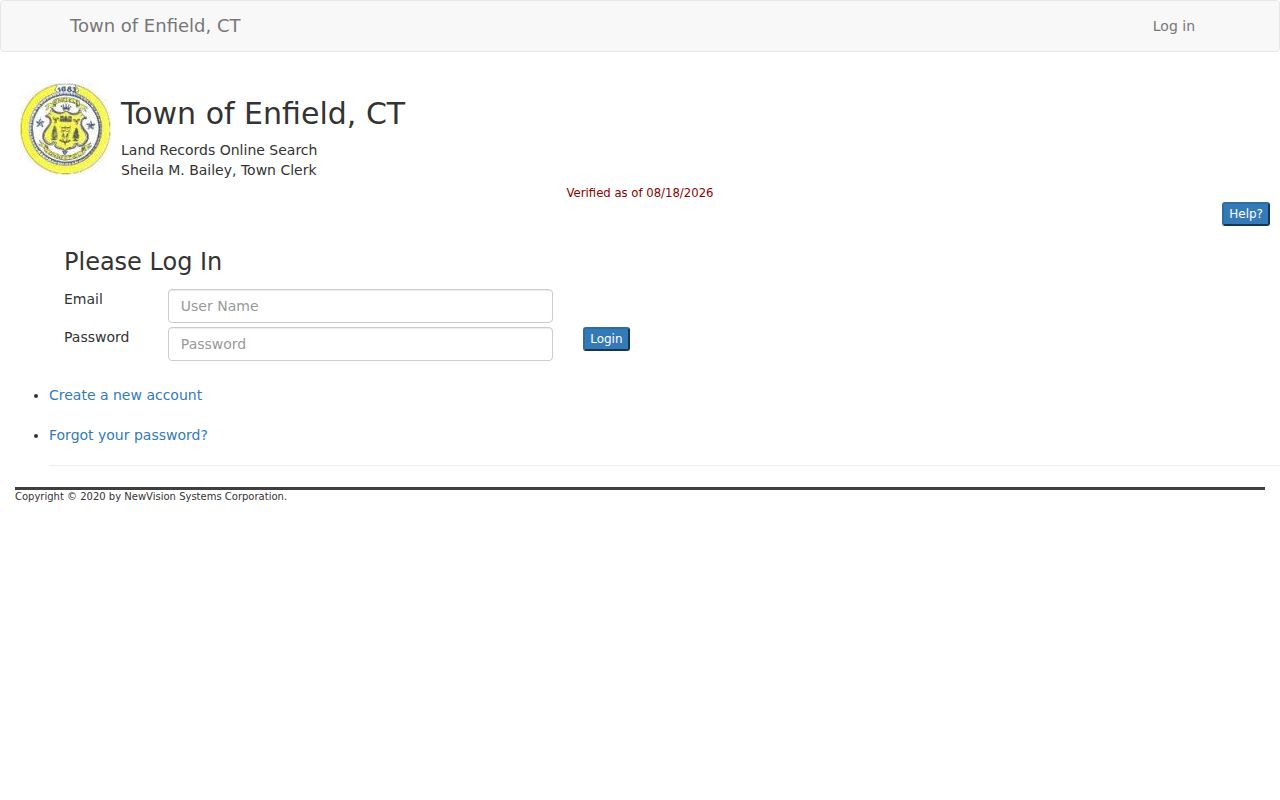
The index can identify a recorded instrument and its parties, but the image or full document may require login, payment, or a clerk request.
Enfield Land Records and Catalis
The Town Clerk’s public description currently places the online land-record index from November 1961 forward. A March 2026 operations report says year one of a Catalis re-indexing project was complete and that the town expected online coverage to return to January 1960 after the new indexes were loaded. Those are two different statements in time, so a researcher should check the live cutoff before searching for an older deed.
For earlier work, the fallback is not a missing county recorder. Connecticut records land at the town level. Ask the Enfield Town Clerk about deed books, maps, a specific party or instrument, or a narrow date range. State Library directory material and the State Archives can bridge older gaps, and the Connecticut FOI process can help with an identified record. FOI does not require an agency to create a complete resident history from a vague name request.
The Town land-record and Property Alert page also explains the free index, image charges, and the alert service. Property Alert watches for a deed or mortgage recorded under a chosen name. It can produce same-name matches, so it is a monitoring aid, not proof of ownership or residence.
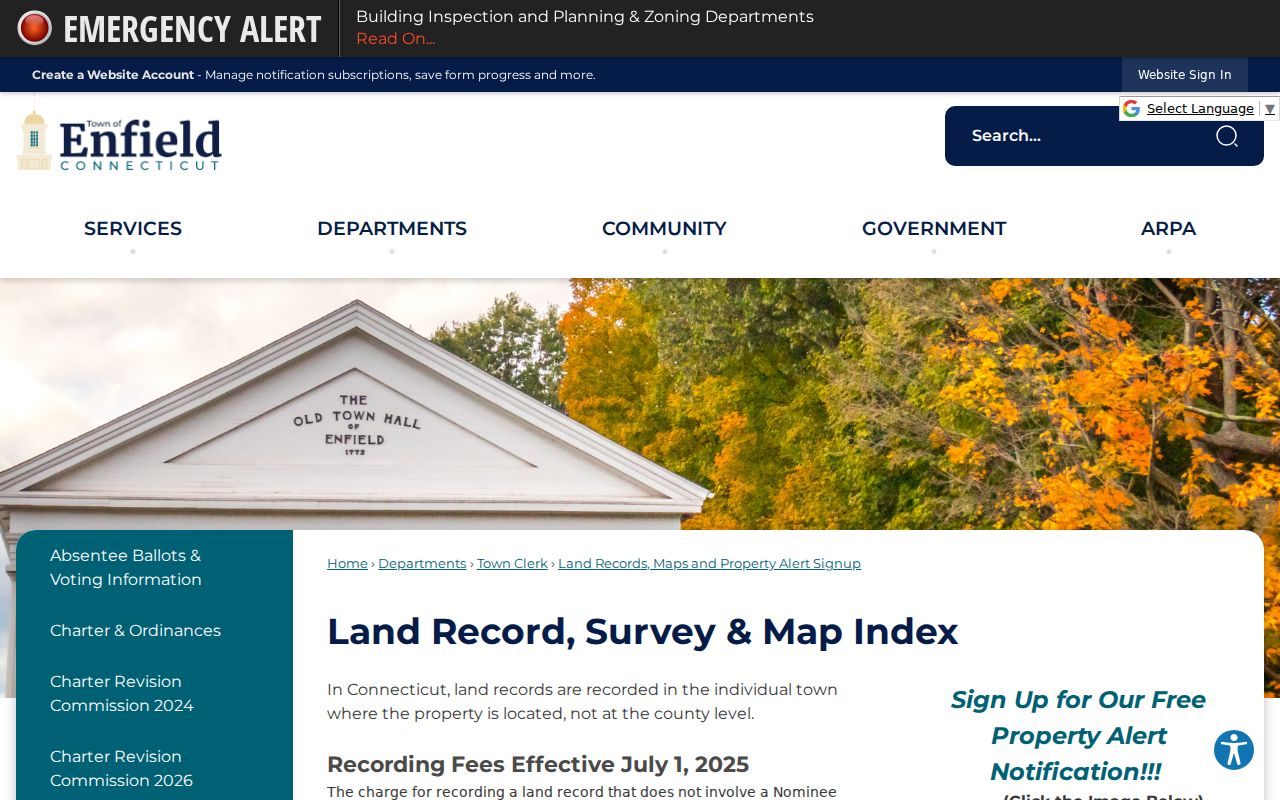
The town page is a useful handoff point when an online result stops at the index and a researcher needs the right local custodian.
Note: Cite the live cutoff and Catalis target with their dates when recording a search result.
Five Enfield Eras of Address Records
A strong address story can layer five kinds of evidence: the 1855 Smith map for broad place context; a 1869 atlas plate for Enfield, Scitico, Thompsonville, or Hazardville; an 1891 or 1901 directory entry for a named person and occupation; a 1909 Yale photograph or 1912 Sanborn sheet for a house or building setting; and the current GIS, Vision, and deed record for today’s parcel.
Each layer answers a different question. The map can show a road or river. The directory can supply a printed address. The photograph can identify a named home or church. The Sanborn sheet can show a footprint or industrial use. The current card can show a situs, owner, mailing address, and value. The sources become useful when their dates and roles stay visible.
For family and house history, the library’s local-history page, Yale photographs, Enfield Historical Society finding aids, State Library directory and map scans, and Town GIS, assessor, and deed records form a distributed research shelf. EHS finding aids include buildings, businesses, government, clubs, societies, and genealogy files, with access limits to check before requesting a folder.
Do not turn a historic place name into a modern street equivalence without checking the legal description or parcel. The official research located no verified Enfield street-renumbering year. Preserve the original wording instead.
Enfield Scantic Records for Past Residents
Enfield’s physical setting can explain why a past-resident trail needs maps and building records. Hazardville grew around the Hazard Powder Company after a 1835 purchase of roughly 500 acres along the Scantic River, and the town describes about 125 historic buildings. Thompsonville’s carpet-company, river, and rail history gives a different address context.
For a house in one of those areas, compare the historic map or Sanborn footprint with the Town GIS parcel, then use the Press, directory, and deed sources to separate a building story from a people story. A factory, church, or named home can anchor the place without proving that every person connected to it lived there.
The Enfield Historic District Guide gives address-level hooks such as Enfield Street 1291-1293 from 1860, 1295 for the 1848 Congregational Church, and 1387 for the 1782 Historical Society. Use those examples to compare construction date, place, and later names, not to assume that the first building date identifies every past resident.
Note: A named building or cemetery clue still needs a dated person source before it becomes residence evidence.
Walk Enfield’s Deed Records Back
Ownership research begins with the current parcel, not with a surname copied from an old directory. Use Vision to save the situs address, owner or co-owner, mailing address, MBLU, account, PID, legal description, and map reference. The card may also show valuation year, land, improvements, total value, building subareas, extra features, land use, zone, neighborhood, and sales or ownership history. Then search the Town Clerk index for the current owner as a grantee near the acquisition date. The seller named in that instrument becomes the next person to search.
The grantor and grantee can change at every step. A trust, estate, business, mortgagee, or executor may appear in the index without being a resident, so use the linked instrument and a directory or Press notice when the question is who was named at the address.
- Save the current Vision card and confirm the parcel in Enfield GIS.
- Search the Town Clerk Party Name index for the owner as grantee, adding date, document type, town, or parcel filters when needed.
- Read the instrument number, date, book/page, legal-description line, prior reference, and linked documents.
- Search the grantor as a prior grantee, then repeat backward while preserving spelling, trusts, estates, and entities.
- When the online range ends, ask for the earlier town book, map, image, or a narrow clerk research request.
- Grantor
- The party transferring an interest in the recorded instrument.
- Grantee
- The party receiving that interest in the recorded instrument.
- Chain of title
- The linked sequence of recorded transfers that connects a present interest to earlier instruments.
- Legal description
- The written land identity in a deed, which can remain useful when an old street number changes.
- Instrument
- A recorded document such as a deed, mortgage, release, easement, lien, or correction.
Pair Enfield Directories With Census
Deeds answer recorded ownership. Directories and census schedules add household context, but they are snapshots rather than a continuous resident roll. Enfield’s known directory anchors are 1891 and 1901, while federal census schedules become available according to the 72-year release rule. A street or village label may differ between the two sources.
Keep both records in their original form. A directory may omit children, boarders, or other people at an address, while a census reflects one enumeration date and its own address conventions. Compare the records, then use a Press notice, deed, map, cemetery, or probate source before treating the match as one household.
- Write the printed name, initials, occupation, village label, and address exactly as the directory shows them.
- Check the nearest released census year and record the household members, ages, birthplace, and occupation fields.
- Compare the directory and census without forcing the same street spelling or household shape.
- Use the Press, deed, map, cemetery, or probate source to test identity and date.
- Directory snapshot
- A dated printed list that may name residents, businesses, occupations, or addresses but may omit people.
- Enumeration district
- The census area used by an enumerator; it helps locate a schedule but is not a parcel boundary.
- Address continuity
- The evidence that an old printed place or street label refers to the same land or building later.
Enfield Probate Records and Press Clues
An obituary can name a former address, spouse, family link, or cemetery. A probate case can name an executor, fiduciary, heir, estate, or later filing. Those details can close a past-resident trail, but they do not convert an old mention into a current address. The North Central Connecticut Probate case lookup begins its readily searchable data on January 5, 2011, so older files may require the court or State Library.
Use the Enfield Press collection for a dated notice, then compare the name with a directory, vital record, cemetery plot map, or deed. The library’s title sequence is Thompsonville Press from 1880 to 1969, Enfield Press from 1969 to 1983, The Press from 1983 to 1984, and The Enfield Press from 1984 onward. It holds microfilm from 1880 to 2018 and describes digitized copies through 2020. The Enfield Historical Society’s digital content includes cemetery plot maps and photographs. A plot is a burial artifact, not proof of residence, kinship, or present contact information.
The Enfield Historical Society digital-content announcement identifies the cemetery-map and image layer used in local historical research.
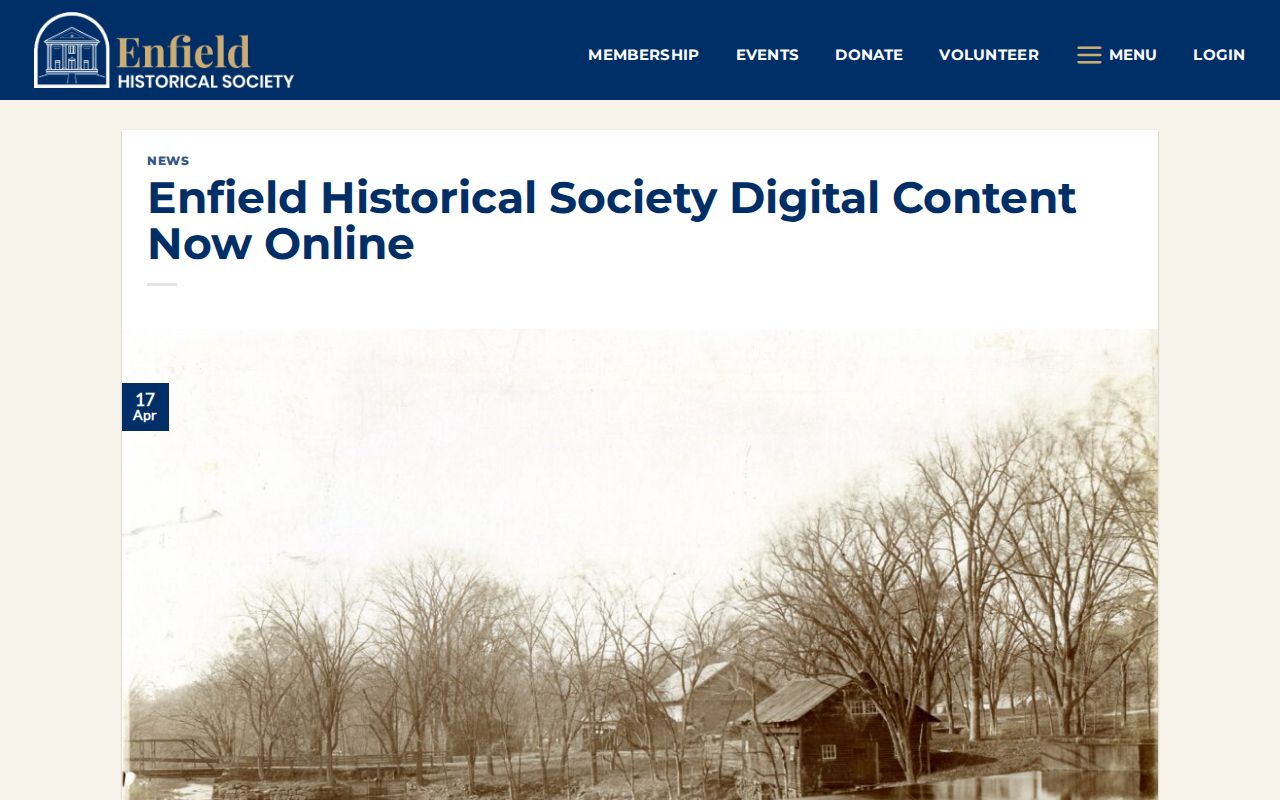
Historical Society material can supply a name or place lead, while the dated directory, deed, and newspaper supply the evidence needed to interpret it.
Enfield Households Across Time
Ownership and occupancy are related but not identical. A directory can place a person at an address, a deed can name an owner, a census can show a household on its enumeration date, and an obituary can refer to a former home. The Enfield city directory page holds the collection-reading detail; the backward trail uses only the entries needed to test one address. Previous residents are strongest as a finding when two dated sources point to the same parcel or printed address.
Record the source date, printed place, role, and exact wording. If a person appears in the business section or in an advertisement, label that context. If an old address is only a village name, compare the map and legal description before assigning it to a current street. Do not call someone a previous resident from a broad name match alone.
Lawful house history. Enfield previous-resident research is suited to house history, family history, and personal curiosity. Do not use a record trail to watch, harass, intimidate, or track a living person.