
Enfield's Historical City Directory Shelf
Enfield's historical shelf is a group of related sources rather than one continuous book. The local Press run, directory anchors, photographs, historical society files, and maps each put names and places into a different kind of record. A printed entry can place a person near a street. A newspaper notice can explain why the name appeared. A map can show the village setting, while a family file can connect a person to a church, club, school, or industry. Hartford County remains useful for court and archive context, but the Enfield Town Clerk and local repositories hold the town-level material.
| Collection | Years | Where Held | Access |
|---|---|---|---|
| Thompsonville and Enfield Press | 1880-1969 Thompsonville Press; 1969-1983 Enfield Press; 1983-1984 The Press; 1984-present The Enfield Press. Microfilm 1880-2018; digitized copies described through 2020. | Enfield Public Library and Connecticut Digital Archive | Local-history help, microfilm, digital copies, and library databases |
| Enfield directory | 1891 | Connecticut State Library and legacy ContentDM record | Digitized catalog route and State Library research access |
| Regional and village directories | 1901 | Connecticut State Library report and scan collection | Runs described for Thompsonville, Windsor Locks, Warehouse Point, Hazardville, Scitico, and Shaker Station |
| Yale Photographic Collection | 1909 glass slides | Enfield Public Library | Online photographs with homes, people, cemeteries, roads, businesses, churches, and agriculture categories |
| Historical Society finding aids and digital content | Multiple historical dates | Enfield Historical Society and Connecticut Collections | Online finding aids, genealogy files, maps, cemetery content, and collection-specific access |
| State Archives individual indexes | Hartford County court indexes 1836-1951; Civil War enlistments 1863-1865 | Connecticut State Library State Archives | Name index first; original records follow the Archives access route |
| Historical atlases and Sanborn sheets | 1855, 1869, 1885, 1892, 1905, 1908, 1912 | Library of Congress and UConn MAGIC | Online map scans for roads, buildings, villages, and industrial context |
These rows show both the strength and the limits of Enfield's historical directory material. The known printed anchors are 1891 and 1901, while the Press supplies a much longer dated chronology. There is no complete continuous directory run after 1901 in the located official sources. The later printed publisher and year run needs verification, and the exact reverse or criss-cross details need verification from the volumes or the library shelf. Reference Solutions and other library databases may fill some modern years, but vendor coverage is not the same as a confirmed local printed run.
The Enfield Public Library local-history collection is the practical first stop for the Press chronology, microfilm, digital material, and reference-desk help with gaps.
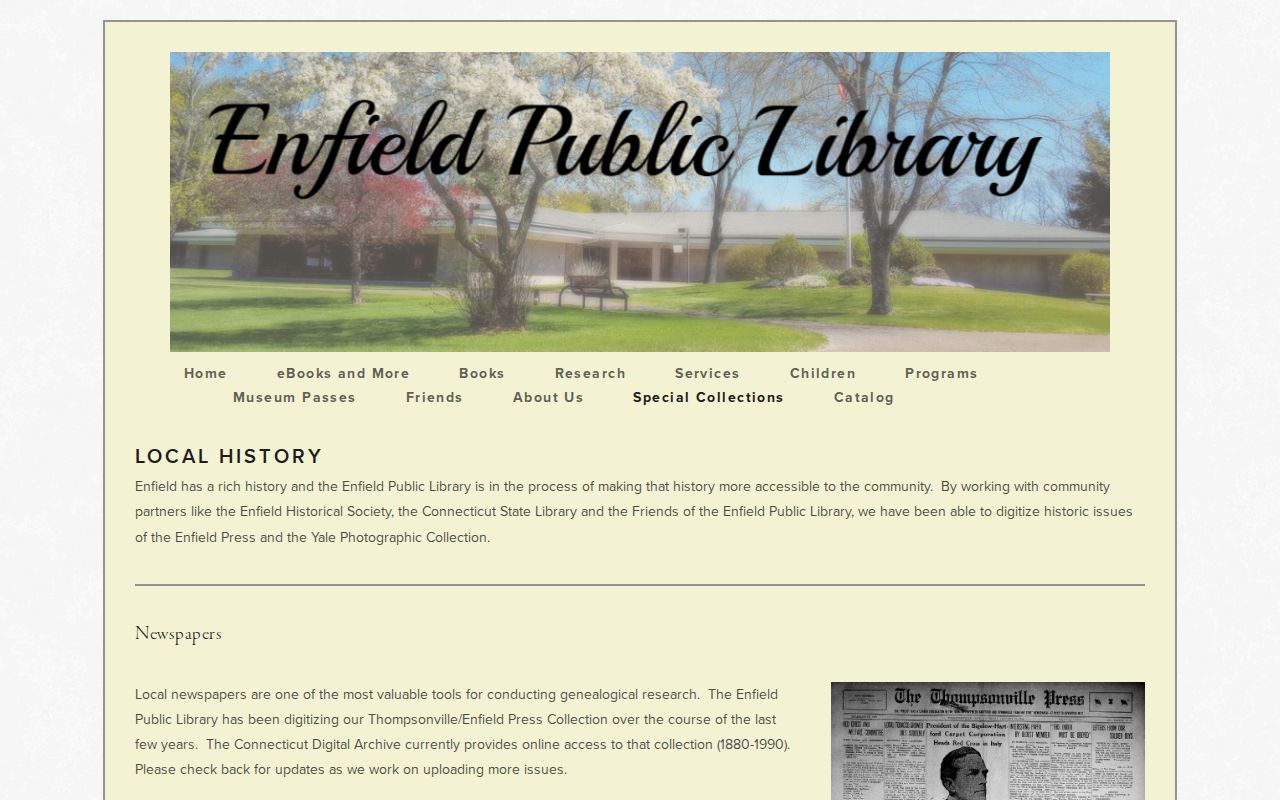
The library's history resources place directory research beside newspapers, Yale slides, and other local collections, making it easier to test a printed name against a second source.
Note: no complete continuous directory run after 1901 was located, so missing years should be recorded rather than filled by assumption.
Enfield Press and City Directory Clues
The Enfield Press is the most useful recurring local-person source beside the historical volumes. Its title sequence begins with the Thompsonville Press in 1880, changes to the Enfield Press in 1969, becomes The Press in 1983, and takes the title The Enfield Press in 1984. The library reports microfilm from 1880 through 2018 and digitized copies described through 2020. Search by a date or name, then read the surrounding notice rather than treating a single mention as a complete record.
Press material can include births, marriages, deaths, obituaries, civic notices, business advertisements, school items, public meetings, society news, and notices that carry an address. Those categories have different weight. A legal notice may use a mailing address. A photograph caption may identify a family or donor. An obituary may name a former residence. A directory entry, by contrast, is a dated listing with its own scope and omissions. Keeping the source type beside the name prevents a newspaper appearance from becoming an unsupported claim about current status.
The Enfield Public Library databases page adds Ancestry Library Edition, FamilySearch Library Affiliate access, HeritageQuest, Hartford Courant archives, Reference Solutions residential-directory material, Gale Directory Library, Biography Reference Bank/Center, and History Reference Center. Some are licensed for library use or require a library terminal or card. They are useful fallback channels when a printed volume is missing, but each database has its own coverage and search limits.
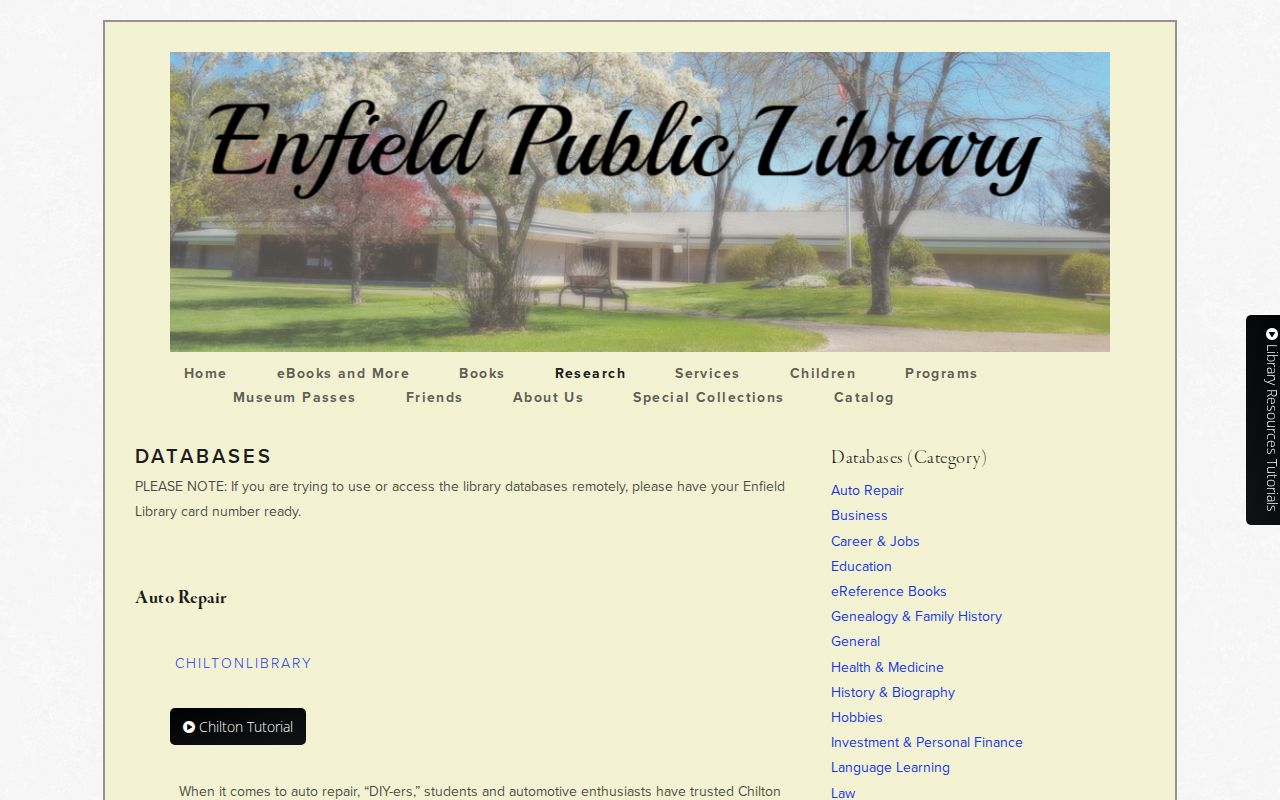
Library database access broadens the search without erasing the need to save the publication date, collection name, and page or result citation for each finding.
Inside Enfield's 1891 Directory Record
The Connecticut State Librarian's report identifies a scanned 1891 Enfield directory that lists residents, occupations, and addresses. That description makes it a first-class historical source for linking a name to a place in a particular year. It should still be read as a snapshot. A person may appear in a resident list, a business list, a professional list, an institution list, or an advertisement, and those sections do not carry the same meaning.
The legacy State Library ContentDM record for the 1891 directory is the catalog route supplied in the report. The live sample page was not readable during the unattended inspection. Do not invent spouse notes, owner marks, widow notation, page numbers, or an abbreviation key from a generic directory pattern. Capture the printed name, place label, occupation, and address only when the scan or a physical copy supports them.
The 1891 material also deserves careful place handling. Enfield, Thompsonville, and Hazardville can appear as headings or location labels. Transcribe the printed label first. A later research note can normalize the geography, but silently replacing one village name with another can hide the way the directory was organized.
The catalog entry's directory record preserves the link between the State Library description and the older digital route.
The catalog view is a research lead, not a substitute for checking the page image or printed volume when an exact entry matters.
Note: the legacy scan was not readable during inspection, so spouse, ownership, and abbreviation marks remain unverified.
Enfield's 1901 Village Directory Trail
The 1901 regional material widens the meaning of an Enfield directory. The State Library report describes runs for Thompsonville, Windsor Locks, Warehouse Point, Hazardville, Scitico, and Shaker Station. A search for an Enfield family should therefore preserve the village or settlement heading exactly as printed. The four historic Enfield sections named in town material are Enfield, Thompsonville, Hazardville, and Scitico, while the 1901 group also reaches nearby places that may appear in the same regional research path.
These labels are not interchangeable. Thompsonville's river and rail setting, Hazardville's Scantic River and powder-company landscape, and Scitico's separate place history can change which address, map, or newspaper page is relevant. A directory name beside a village heading can be a stronger lead than a broad town search, especially when a surname is common.
- Keep the printed settlement heading in the citation, then add a separate normalized town field.
- Search Thompsonville and Hazardville separately when a family record gives only a village name.
- Check Scitico and Shaker Station as place labels before assuming an entry belongs under an Enfield heading.
- Use Windsor Locks and Warehouse Point as regional comparison points, not as proof that a person lived in Enfield.
The 1901 runs are an important anchor, but they do not establish a complete year-by-year series. Later directory shelves and any reverse section must be confirmed with the library or State Library rather than inferred from the 1901 description.
How an Enfield City Directory Entry Reads
A useful directory entry is more than a name. It has a printed role, a place label, and a date that define what the line can prove. The research description for 1891 supports resident name, occupation, and address fields, along with a separate business-directory structure. It does not expose a readable sample page for every mark. A field inventory separates documented details from marks that still need a scan check.
Read from the top of the page down. First record the village or town heading. Then preserve initials, spelling, punctuation, and street wording. Copy an occupation as printed, without expanding an abbreviation unless the volume's legend supports it. If a second section repeats the name, label it as a business or institutional entry. That method keeps a printed listing distinct from a later interpretation.
| Resident name | The person line described by the State Library report; retain spelling and initials. |
|---|---|
| Occupation | The printed occupation field, copied as shown and not expanded without a verified key. |
| Spouse or household note | Possible directory detail in some runs, but the 1891 live sample did not expose it for verification. |
| Street or place address | The address or village label attached to the entry; transcribe before normalizing. |
| Ownership or residence mark | Do not assume a symbol, owner mark, or occupancy notation until the specific volume confirms it. |
| Separate business listing | A second listing may describe a place or institution rather than a household address. |
Directory terms
- Criss-cross directory
- An address-first or street-order section used to move from a place back to a listed name. The exact Enfield years and format need verification.
- Householder index
- A name-oriented list of household heads or primary entries. It is not a promise that every person at an address appears.
- Abbreviation key
- The volume's legend for shortened words, street labels, or directory marks. Locate it before expanding any entry.
Note: a directory field is useful only when its section, heading, and date stay attached to the copied name.
Yale's 1909 Enfield Homes and People
The Enfield Public Library's Yale Photographic Collection adds visual context to the directory shelf. Rev. David Lewis Yale created the 1909 glass slides while connected with the First Congregational Church. Its categories include Homes, People, Cemeteries, Bridges, Roads, Dams, Businesses, Churches, and Agriculture. The Homes material names properties such as Conor Home, Ash Home, Pierce Home, Strickland Home, and Parsons Home. A name may refer to a family, house, or donor, so the caption needs to be paired with a directory, deed, map, or historic inventory.
The Enfield Public Library Yale photographic collection is especially useful when a directory gives a place but not enough context to understand the setting. A bridge, road, factory, church, or cemetery can explain why nearby sources use a particular village heading. The photograph remains evidence of the photographer's date and caption, not a complete list of people who lived at the property.
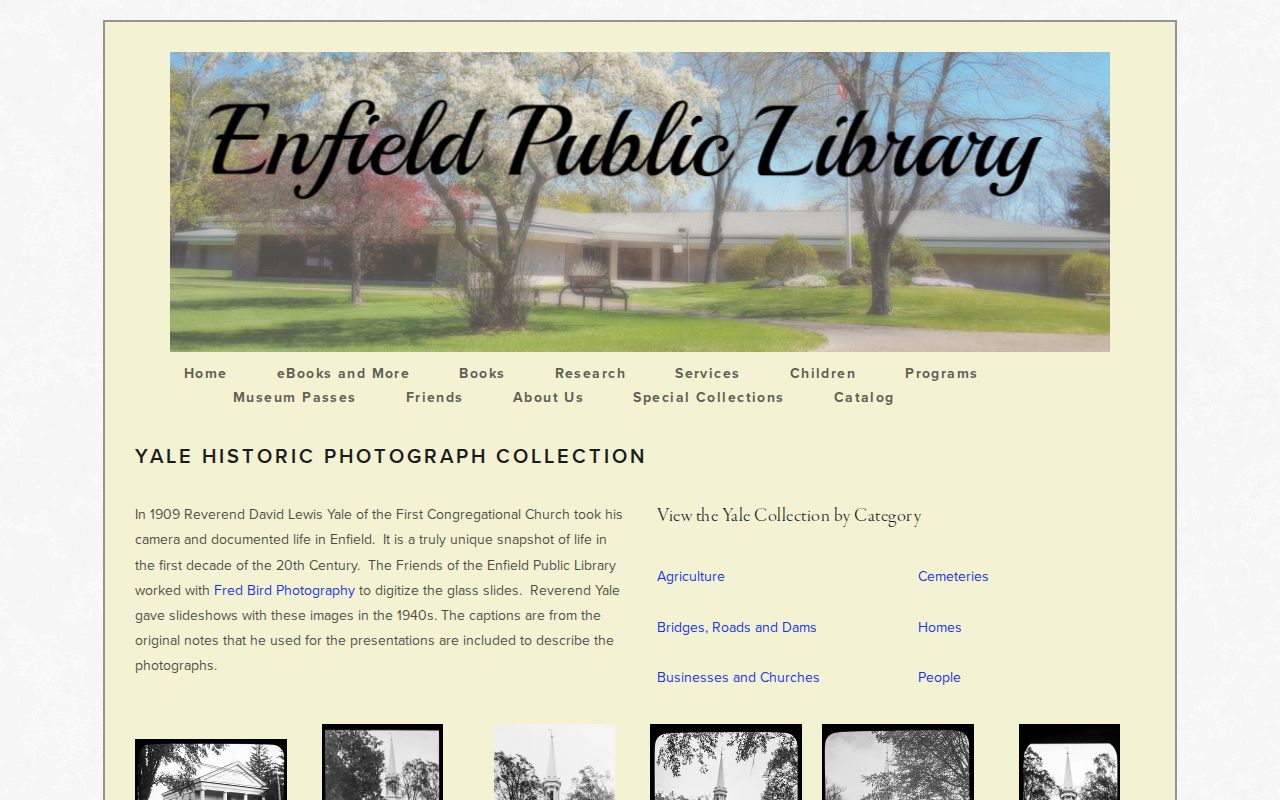
The Yale categories let a name-and-address lead expand into a local place story without turning a historical image into a current resident record.
EHS Finding Aids for Enfield Families
The Enfield Historical Society supplies the manuscript layer that printed volumes cannot. Its finding-aids and links page points to Schools, Businesses, Government, Buildings, Clubs, Organizations, Societies, carpet companies, Hazard Powder Company, Hazardville, Military, Shakers, and early Enfield material. The genealogy vertical files include GEN 01 Brainard, GEN 02 Hazard and Harris, GEN 03 Olmstead and Moore, GEN 04 Bridge and Gordon, and GEN 05 Hurlburt and Russell.
Those headings can connect a person to a family cluster, building, institution, or organization. Manuscript collections such as Anthony Secondo Enfield History, the Mike Miller archive, Martha Parsons House, Frew, Christine DePellegrini, and Episcopal Churches may add names, photographs, or notes that do not appear in a directory. Read the finding aid before contacting volunteers. EHS warns that a response can take days or more, and collection restrictions still apply even when a title is visible online.
The EHS research links also point toward maps, Sanborn sheets, and historical house material. That makes the Society a good fallback when a directory year is missing, but an absent online description does not show that a file does not exist.
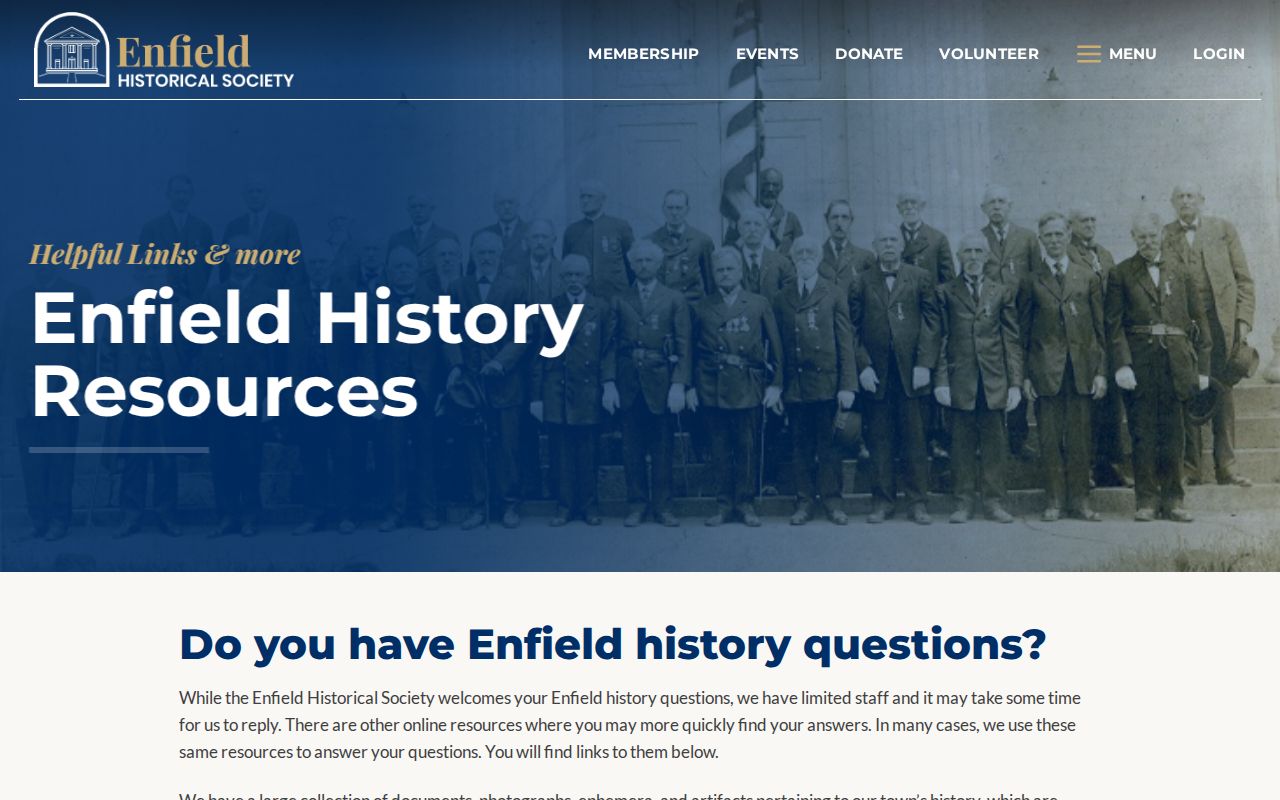
The holdings view is a reminder to search by family, building, organization, and village, not only by a modern street address.
Enfield Digital Collections and Cemetery Clues
Connecticut Collections provides another access channel for Enfield historical material. The Enfield Historical Society digital-content entity includes digitized photographs, ephemera, and cemetery plot maps. A plot map can locate a burial space or point toward a family group. It is not a current address and does not prove kinship by itself. Pair the plot clue with a dated obituary, directory entry, vital record, or family file.
Map layers help explain why the same name may appear under different local headings. The Library of Congress map scans provide a 1855 Smith map, 1869 atlas plates, a 1908 Enfield and Thompsonville bird's-eye view, and Thompsonville Sanborn sheets for 1885, 1892, 1905, and 1912. The UConn MAGIC map collection is a useful state-level route when a town map needs a second repository.
Keep the source roles separate. A directory snapshot, newspaper notice, photograph, cemetery map, and atlas plate can reinforce one another, but none should be rewritten as a complete current resident list.
The Connecticut Collections entity keeps the digital cemetery and image route near this map sequence. The map sequence is valuable for house and family history because it shows roads, buildings, factories, churches, and village form across time. It does not fill the exact gap in the later printed publisher and year run, and it cannot supply the missing reverse-directory details.
The Connecticut Collections route gives a researcher a digital place to test cemetery and image clues before requesting deeper material from the Society.
Tracing Enfield Families Across City Directories
A household trail works best when each directory year is treated as one fixed point. Begin with the clearest name and place combination available, then move through the local shelf in small steps. The purpose is not to make a missing year look complete. It is to show which source supports each change in spelling, address, occupation, household note, or village heading.
- Start with the 1891 Enfield directory or a 1901 village run when the name and place fit. Copy the heading, page, spelling, and section exactly.
- Read nearby entries and any separate business or institution section. Note initials, occupation, address wording, and possible household marks without expanding an unclear symbol.
- Move to the next available directory or Press notice. Record whether the name continues, changes village, appears in an obituary, or disappears without an explanation.
- Pair the dated directory snapshot with the closest released federal census schedule. Compare household members, age ranges, occupations, and place labels, while allowing for different street numbering and village terms.
- Test the address against a deed, map, cemetery plot, EHS file, or later newspaper notice. When a present-day parcel question remains, use the current address-record chain rather than stretching the historical volume beyond its date.
Released federal census schedules follow the 72-year rule, so the appropriate census year depends on the period being studied. National Archives or official census access can fill a decade between directory anchors, while FamilySearch and library databases may provide a different search route. A missing name can mean a move, death, an omitted child or boarder, a different village heading, or simple coverage limits. It does not by itself prove that the person left Enfield.
| 1683 | Enfield was established and named by Massachusetts; early town recordkeeping developed locally. |
|---|---|
| 1749 | Enfield was annexed to Connecticut, while the town remained the practical local records setting. |
| 1880 | The Thompsonville Press chronology begins. |
| 1891 | State Library description of the Enfield directory listing residents, occupations, and addresses. |
| 1901 | Regional and village runs describe Thompsonville, Windsor Locks, Warehouse Point, Hazardville, Scitico, and Shaker Station. |
| 1909 | Yale glass slides document homes, people, cemeteries, roads, businesses, churches, and agriculture. |
| 1912 | The last specifically identified Thompsonville Sanborn sheet in the mapped sequence. |
| 1984-present | The Press title sequence is identified as The Enfield Press; this is newspaper coverage, not a verified continuous directory run. |
When a historic entry needs a present-day name check, the Enfield resident lookup can point to the appropriate modern record type. When the question shifts to one address and its current parcel history, use the Enfield street directory approach. Both handoffs preserve the historical shelf's main value: a dated, cited snapshot that can be tested rather than overstated.
Note: a directory date anchors a printed snapshot, while a deed, obituary, or map answers a different historical question.